
1st Lieutenant Ángel Martinez
Name Ángel Martinez
Position Marine Officer
Rank 1st Lieutenant
Character Information
| Gender | Agendered/Non-Binary | |
| Species | Human | |
| Age | 37 |
Physical Appearance
| Height | 5'7" | |
| Weight | 140lbs | |
| Hair Color | Dark brown | |
| Eye Color | Dark brown | |
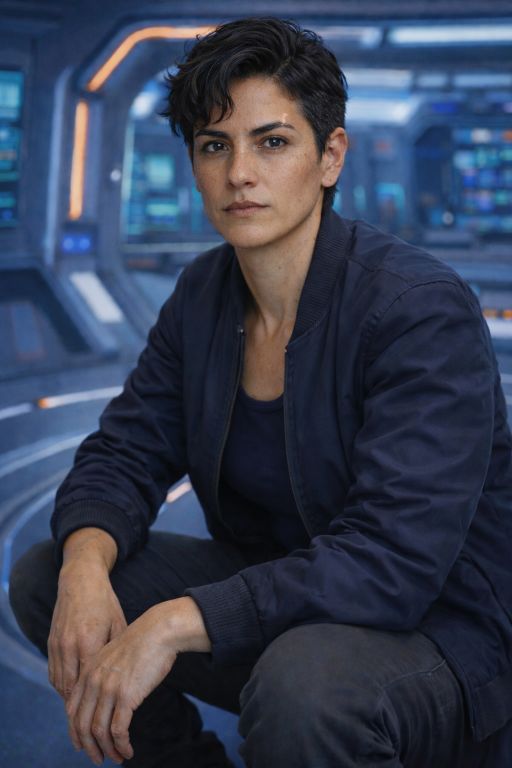
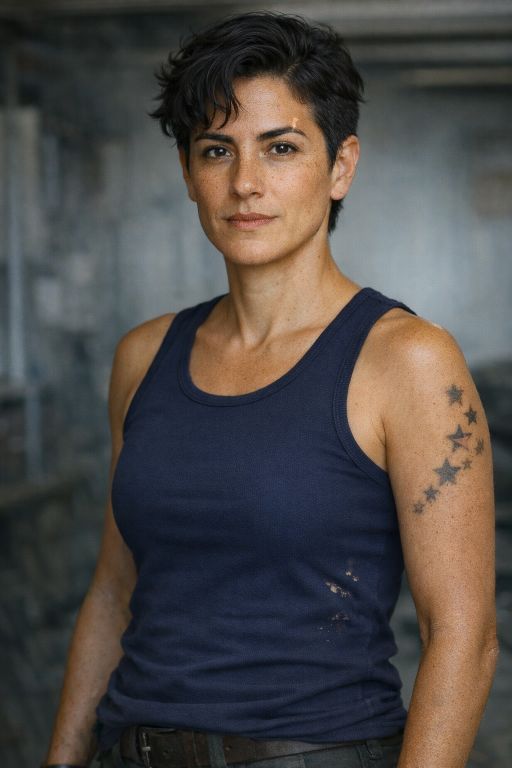
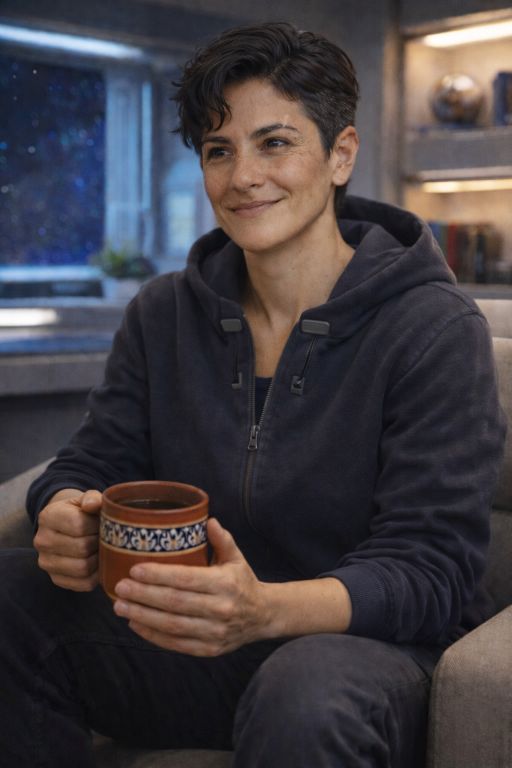
| Physical Description | Martinez’s natural built is lean and wiry, the kind of compact strength that comes from carrying kit and running on too little sleep for too many years. While not unattractive, they move with the economy of someone who was trained to move for lack of sound, not elegance. Their high cheekbones and straight nose adds enough interest and strength to set off the dark brown hair with soft curls in it. They carry their scars though: a thin pale notch cuts the outer edge of the left eyebrow from a 2374 shrapnel blast that they decided not to get the scar removed from. Smaller nicks mark the bridge of the nose and the right cheekbone. There is a short ladder of old shrapnel pocks along the left ribs and a faint surgical seam low on the right flank where a fragment was taken out late in the war and the resources didn’t stretch to get the scar removed. Their hands are calloused from work and they keep their nails short, and there are fine scars crossing the knuckles and finger pads; the left ring-finger knuckle sits a touch high from an old break that even to this day they haven’t bothered to fix. They have a tattoo on their arm of stars, shaded in, in memory of their brother with a scar cutting across one of them. |
Family
| Father | Javier Martinez | |
| Mother | Lucia Martinez | |
| Brother(s) | Diego Martinez (deceased, 2374) | |
| Sister(s) | Marisol Martinez, Translator specialist, Titan Lt. Sofia Martinez, Medical Officer, USS Amsterdam |
|
| Other Family | Julio Martinez-Brown, age 2 (nephew, Marisol's son) |
Personality & Traits
| General Overview | Martinez has always had a good sense for who gets overlooked and focuses in on them: the quiet ones at the edge of the squad, the rookie who flinches when someone shouts, the person holding everything together until they don't…Maybe it comes from years of having to identity the breaks or else the squad dies, or maybe it’s older than that. Either way, they’ve never been one to chase noise or recognition. They just keep showing up. They’re the sort of officer who tries to make the space they inhabit steadier. They’re calm in a firefight, clear on comms, and able to spot the moment someone needs a word to hold onto. Their leadership style leans practical: keep the tempo clean, the drills realistic, and the pressure off until the real thing hits. When someone slips up, correction happens in private. When someone steps up, they remember it. They know the weight of being seen. Martinez doesn’t tolerate theatre, hazing, or tests that chip away at people. They’ve served under commanders who did and regret it. These days, their principles are quietly baked into the way they run a team: no bravado, no unnecessary pain, and no pretending that silence means strength. They will bend a plan if it means keeping someone breathing. The paperwork can wait. They’re warm, but not showy. Quick to brew café de olla for a long watch. Known for zip-clip fidgeting during planning, the occasional joke slipped in like a splint, and a habit of checking on the person who says they’re fine a little too quickly. Trust takes time with them, but when it’s there, it holds. They are the kind of person who remembers small things of others, such as aa scar, a shoulder strain, a silence, and carries them quietly. When it comes to relationships, things…have been casual, never any large declarations of adoration. They’ve loved before, let go when it was time, and stayed in touch when it mattered. There is a soft cadence to their voice when they’re tired, more Spanish in the vowels. Family knows them as elle just as easily as they/them. They do not collect medals and have turned down at least one that felt more like an apology than an honour. |
|
| Strengths & Weaknesses | Strengths: Martinez tries to lead calmly and has a people-first mindset. While they will always appreciate the mission, they are focused on completing it with as little casualties as possible. They are very clear when they communicate, steady when the pressure is strong and notices the cracks in a team. They have a strong moral compass, forged from having suffered under abusive leadership in the 77th. Weaknesses: The same moral compass also makes them less than a great Marine. They can question orders if they seem too harsh, and tend to carry burdens alone. They do not push for recognition and will often step back when time comes to receive praise. Sometimes, they have a reckless streak, tied into the desire to make sure everyone gets home. |
|
| Ambitions | To do better than the officers they served under during the Dominion War, and to show that you don’t have to turn to ice to survive. | |
| Hobbies & Interests | Martinez has a variety of hobbies and interest. They used to play in their last posting’s zero-g handball league, and they also were parts of weekly game nights of kadis-kot. They also enjoy cooking, although it is mostly the beverages from their mother’s kitchen that gets recreated than the actual food. They grow chili plants or certainly used to on their last posting. They also enjoy exercise, claiming it calms their mind down. They enjoy a good book, especially historical adventure ones. |
| Personal History | Ángel Martinez grew up in New Vallis, Mars, the middle child in a Martian-Hispanic household where hospitality sat alongside habit. For the Martinez family, Spanish was the language of jokes, songs and comfort while Federation Standard handled school and yard paperwork. Their parents worked shifts connected to the Utopia Planitia Fleet Yards, one in dock operations, the other in logistics, so dinner talk was full of dry-docks, workbees and launch windows. Replicators were ordinary, but the family still kept a small hydroponic tray for herbs because fresh hierbabuena turned tea into a welcome. In classic Martian style: neighbours came and went through an always-open doorway, handed a mug before a question. Safety was second nature rather than fear whenever Ángel was at the Fleet Yards: check the status light, mind the pressure door, mind your footing on the tram. On the terraformed Mars, it was running around in streets with red dusting it. Praise was practical: Good hands, good attention….thank you. From an early age, Ángel had a quiet knack for keeping things running in the house. They returned tools to the board without being asked, labelled storage in both Spanish and Standard so even guests would find it, and helped a parent inventory parts on a PADD before a yard delivery because if you were old enough to read and walk, you were old enough to help in the Martinez household. School trips peered through viewing galleries at starship skeletons while workbees stitched sparks along their ribs, and Ángel absorbed the rhythm of systems without making a fuss. When a drill sounded they moved the younger sister ahead and counted calmly, more shepherd than show-off. The humour that arrived was dry and kind, landing on the half beat after a wobble. When they were ten they cracked the left ring-finger knuckle helping set a makers’ club frame, hid the sting and finished the job; it healed a touch high and became a lifelong tell when they thought. By then they already moved like a small hinge in a larger machine, smoothing edges with quick fixes…mag-seal patches, poly tape and zip-clips…a straightened strap, a shared love of condiments that made replicated food feel more like home, and words exchanged with warmth and love. From ten to twelve, Ángel settled into being the quiet hinge at home and at school. Makers club after lessons, small repairs for neighbours whenever someone didn’t want to replicate something new but rather repair what they had, herb cuttings traded across the corridor. They learned basic first aid through a community programme run by Fleet Yards volunteers and found they were good at calm instructions and steady hands. Weekend viewing galleries at Utopia Planitia were a favourite. They watched workbees stitching light along starship ribs and absorbed the lesson that systems work because people do the small things right. They started running the tram routes for fun, built endurance rather than speed, and kept a younger sister in sight without being asked. When they were around twelve or thirteen they tried a few looks…changed their hair, getting it cut shorter, and started using more neutral styles. One morning at breakfast they said they were they/them, and in Spanish they preferred elle. Their parents asked if they wanted school and yard paperwork updated. Ángel said yes. It was done before lunch. A grandmother on subspace kept calling them mi cielo and switched to elle without a hiccup. At home it was a non-event. The only practical change was a small family conversation about what to say if anyone at school got it wrong. Ángel practised the line, “They works fine,” and then stopped thinking about it. By fourteen, the caretaker habits had teeth and Ángel logged more hours with the youth emergency group, learned to stabilise a sprain, check an airway, and talk someone through a scare while doing three other useful things, such as prepping a dermal regenerator or operating a hypospray. When a boy froze on a tram during a brief service halt, clearly getting distressed, Ángel gave him their seat, passed a water bottle, and talked him through breathing while flagging a steward. At school they stepped between teasing and the target, sometimes with logistics and occasionally with their own body: never setting out to hurt the bully but to stop anyone getting hurt. The beginning of who Martinez would be as an adult was already there. From fifteen onwards Ángel’s instinct to help shifted from neighbourly favours to purpose. They added evening runs to the tram route, then longer ones out to the viewing galleries with a quietly weighted rucksack because it felt honest. They weren’t sure exactly what they were training for, just that they…wanted to. At seventeen they went to a Starfleet recruiting event at the Utopia Planitia visitor centre and asked questions at every booth. Engineers talked frames and tolerances. Medical talked placement exams and rotations. Security covered station patrols. The Ground Forces table was quiet. A sergeant with a soft voice asked what Ángel did when something went wrong. Ángel answered without thinking: water, check the airway, move them, make space. The sergeant looked at their hands and said, “Good. We need that.” It sat with them for a while. Not speeches of glory, just the promise of work that put them where the problem was, with the tools to change it. The next year became a private training programme built out of ordinary life. Morning runs, bodyweight drills, obstacle parks on rest days. A community gym instructor who had served in the FGF taught them how to fall, how to get up and the theory of how to keep a phaser rifle safe around people. They kept their grades steady, finished the aid certifications, volunteered on drill days and stayed the person who returned tools to the shadow board and labelled things in both languages so anyone could find them. At home they took to brewing café de olla for the family on quiet evenings, the kitchen filling with cinnamon and piloncillo. When nerves needed steadying before a mock drill, they carried manzanilla con canela in a travel cup. At eighteen they told the family over dinner. Their parents asked if they wanted the officer track. Ángel said no. They wanted to do the work with their hands. Paperwork was updated the next morning. Their grandmother blessed them on subspace and sent the family recipe for café de olla, which made everyone laugh. Diego watched everything, fifteen and fierce, already making plans. Ángel hugged him hard, told him to decide when he was old enough, and shipped out a month later for basic training with the Federation Ground Forces. From eighteen, Martinez went straight to Federation Ground Forces basic. They took to the structure quickly. Rifle drills, fieldcraft with tricorders, zero-g and high-g acclimation, close-quarters work, casualty drags and fire team manoeuvres. The aid modules felt natural. They were the recruit who passed water before advice, squared away their kit without being told and learned to fall, get up and keep moving in full gear. They were a thinker, but not physically as strong as some others. Martinez was not perfect and they knew it, so they adapted. Posted to the 58th for a first tour, Martinez learned the rhythm of ordinary hard soldiering. Patrols on colony worlds, relief convoys, the occasional sharp contact that ended as quickly as it began. They built endurance, field sense and quiet authority. Corporals started handing them the PADD when tempers rose because Martinez could talk a knot loose without making anyone lose face. They were the one who could chat to colonists, medics and pilots alike, keep comms clear under pressure and have a joke ready for the ride back that did not punch down. They were social, warm and yet professional where it counted, a reminder that the FGF were still Starfleet, even when fully armed and in tactical gear. That they weren’t as scary as the Marines. The transfer to the 77th changed the weather. Rapid deployments, ugly jobs, a culture that treated care as weakness. New arrivals were tested. Some of it was official. Some of it was not. Martinez was pulled into it as well and learned fast that answering back at the wrong moment made things worse. When they were put in the pit, they did not argue but took the beating and the words of Sergeant Tho. But they remembered, and took note, but never really got rid of the sour feeling of watching those that followed in the pit and knowing they couldn’t interfere. But a small, core squad started forming. Under Sergeant Tho, the five soldiers worked together to stay alive. There was Banik, who never met a fool she wouldn’t kick. Kerren, with his quick smiles and tales of Earth. Raimi, who kept Martinez sane when Tho’s boot felt too heavy on their back and Morven, the quiet one who on the surface could have been seen as Tho’s creature…but Martinez recognised someone already broken. They worked together and fought together. When the Dominion War started, Sergeant Tho felt vindicated. The 77th entered the war fighting for survival. Martinez’s squad fell under Tho, and they learned to block out most of his shouting. A few weeks into the war, Tho was shot by a sniper. If anyone spotted the shooter, no one called a warning. Corporal Morven kept moving and Martinez followed. It became a pattern: Martinez beside Morven, making sure the hard edges of the survivalist did not break anyone in the squad. They respected him, saw the value not just of the soldier, but of the person. They lost people and Tho was not replaced. Still, the entire battalion started to get a reputation. They were as ruthless as the enemy and if something could burn or explode…it did. On the ground, they set forth. It meant they got the positions that command felt were…a bit iffy. Day to day, it was not something that Martinez noticed. Orders came in, they read it, conveyed it to the rest…and they held position when they needed to and pressed when ordered to. No, for Martinez, the war was what it was…until it suddenly became something darker. On 25th December, Private Diego Martinez was killed in action. He had joined months earlier, just gotten through basic before being posted…and subsequently died when his inexperienced unit faced the Jem-Hadar. It froze something in them for a while, shutting them down in ways they did not recognise. Even so, they showed up every op. Still flanked left when Morven flanked right. Still moved like someone who would die for the squad if they had to. But no one lives with something like that forever, and the losses started stacking up. When Private Raimi was killed on a night move, Martinez carried her armour three kilometres back to the fallback line and let nothing touch the ground. Afterwards the façade cracked. They finally let the grief out where it was safest: with the squad. Morven kept watch. It marked a turn, not just for Martinez, but for the unit. Raimi had been a fixer; without her, Martinez stepped into the gap. There were rescues the reports called observation. One camp in a sandstorm settled it. Orders said watch. A POW was executed in front of them. It rocked the squad and raised the question: is disobeying orders wrong if the alternative is unethical? They made the choice together and breached the POW camp. Martinez unlocked cages with steady hands while Morven cleared the way. They were not punished openly, but afterwards command kept them off any operation where a moral call might force disobedience. Patterns settled. By the end of the war, Martinez was the de facto second at Morven’s side, same rank, same weight of choices, the social glue that kept a brutal unit just human enough to get through. They left with scars a medic’s scan would miss and a regret that they had not done more, sooner, when the 77th called cruelty tradition. What they did do, and kept doing, was make sure people drank water, breathed, moved and lived to the next morning. When the 77th was disbanded after the war, Martinez was offered officer training. The 77th had a bad reputation but Martinez had caught enough positive attention from officers to be recommended. Before the war, Martinez wouldn’t have considered it. After the war and feeling adrift, their squad gone their separate ways…Martinez realised that they could change things if they had the rank to reflect it. Martinez accepted Ground Forces officer training and graduated in the top fifteen percent of their year. They were noted for clear comms, small-unit decision-making and an ethics paper on observe-only rules that did the rounds at Training Command. Commissioned as a second lieutenant the following year, they went where the work was messy rather than glamorous. Martinez then served with the 23rd, overseeing a squadron on orbital security and drop readiness assignments across contested borders. It was quieter than the war years but no less complex. Smugglers, failing treaties, and old wounds made diplomacy as important as deterrence. Martinez found themselves running joint drills with local security, managing tensions between junior officers who had never seen a live shot fired, and learning how to hold a line without escalating things past recovery. It was also when they began refining training protocols for first-contact perimeter work — field layouts that balanced safety with clarity, especially in relief corridors where the threat was real but the optics mattered. They were stationed off-world when Mars burned. Their family was safe, their parents retired to Earth, their sisters off planet with their own lives… but the old house in New Vallis was lost, as were friend and faces Martinez knew. That corner of life, with the herb tray by the window and the plan to one day teach weekend drills in the garrison gym, was gone. What stayed was motion. Purpose. Martinez requested a transfer within the month. In the latter half of 2385, they entered Starfleet Marine Corps conversion training. It was not basic again, but it was close. The tempo was different, the terrain wetter, the doctrine sharper at the edges. They adjusted, adapted, and came through it with a new uniform and the same principles. Still taping kits with clear labels. Still checking the rookie's wrist after a fall. Still making sure the perimeter felt safe, not occupied. Their first position as a Marine was the USS Pathfinder, where Martinez served as platoon leader and training officer. They wrote drills that matched how people actually move under pressure and mentored junior officers on speaking to locals in their own cadence. During a Corps of Engineers rebuild on a frontier colony where the Pathfinder was helping out, they met Jasra Pryn, a Bajoran civil engineer. They started dating, although it didn't last more than a few months. By 2389 Martinez holds the rank of 1st Lieutenant in the Marines. They were transferred to the USS Astrea, serving under Major Clay McEntyre III. |
|
| Service Record | 2369–2370 – Federation Ground Forces – Enlisted Basic Training 2370–2372 – 58th Battalion, Federation Ground Forces – Private 2372–2376 – 77th Infantry Battalion (“Black Ash”), Rapid Deployment Division – PFC - Corporal 2376–2379 – Federation Ground Forces Officer School – Officer Candidate 2379–2381 – 11th Rapid Support Battalion – Second Lieutenant 2381–2385 – 23rd Security Operations Division – Second Lieutenant / Lieutenant 2385 – Transfer to Starfleet Marine Corps – Conversion Training 2386–2389 – USS Pathfinder, Marine Detachment – Platoon Leader & Training Officer, 1st Lieutenant 2389–Present – USS Astrea, Marine Detachment – 1st Lieutenant |